Introduction
Owning a motorhome is one of the great freedoms of the open road — but when it comes to finding someone to service one, many owners quickly discover a frustrating reality: most garages simply can’t help.
It’s not a question of expertise. It’s a question of space, equipment, and ramp capacity. A standard car ramp won’t take a motorhome. A standard workshop isn’t tall enough. And an MOT bay designed for hatchbacks isn’t going to work for a 7-metre, 3,500kg vehicle. The result is that motorhome owners across Macclesfield, Knutsford, Wilmslow, Congleton, and the wider Cheshire area often struggle to find a local garage that can actually take their vehicle in.
CSG Automotive in Macclesfield is one of the few garages in the area with the facilities, equipment, and experience to carry out full motorhome servicing and MOT testing. In this guide, we explain what an annual motorhome service covers — and why getting it done properly matters more than many owners realise.
Why Most Garages Can’t Service a Motorhome
This surprises many first-time motorhome owners. You might assume that any competent garage can service any vehicle — but motorhomes present a specific set of practical challenges that rule out the majority of workshops.
Size and Height
Most motorhomes are between 6 and 8 metres long and 2.8 to 3.5 metres tall. Standard garage bays are built around cars and vans, and many workshops simply don’t have the ceiling height or floor space to accommodate a full-size motorhome safely.
Ramp and Lift Capacity
A fully laden motorhome can weigh anywhere from 3,000kg to well over 4,000kg. Most standard car lifts are rated to 3,000–3,500kg — right at or below the limit for a loaded motorhome. Garages without the correct rated equipment either can’t take the vehicle at all, or risk doing so unsafely.
MOT Class
Motorhomes over 3,500kg gross vehicle weight (GVW) require a Class V MOT, which can only be carried out at a station with the appropriate equipment and authorisation. Most standard MOT bays are Class IV only — designed for cars and light vans.
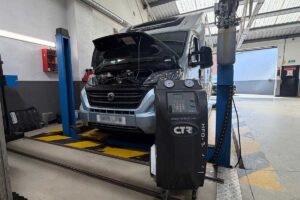
The practical upshot for motorhome owners in Macclesfield and across Cheshire is that the pool of garages that can genuinely help is small. CSG Automotive is equipped and authorised to carry out both motorhome servicing and Class V MOT testing — making us one of the few local options for motorhome owners in this area.
What Does an Annual Motorhome Vehicle Service Cover?
The mechanical service on a motorhome follows the manufacturer’s service schedule for the base vehicle — typically a Fiat Ducato, Peugeot Boxer, Ford Transit, or Volkswagen Crafter chassis. But there are important considerations specific to how motorhomes are used that make this more than a standard van service.
Engine Oil and Filter
Engine oil should be changed annually or in line with the manufacturer’s mileage interval — whichever comes first. Motorhomes often cover low annual mileages, which means the annual time interval is usually the more relevant trigger. Oil degrades chemically regardless of how many miles have been covered, and old oil loses its ability to protect the engine effectively.
Air Filter, Fuel Filter, and Pollen Filter
These should be checked and replaced according to the service schedule. On a heavy motorhome, a blocked air filter has a more pronounced effect on fuel consumption and engine performance than it would on a car.
Brakes
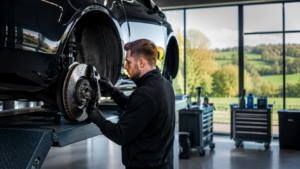
Motorhomes are significantly heavier than cars or vans, which puts far greater demands on the braking system — particularly on hilly routes like those around the Peak District. At every service, brake pad and disc condition, brake fluid level and condition, and handbrake operation should all be inspected. Brake fluid should be replaced every two years regardless of mileage, as it absorbs moisture over time and degrades in performance.
Tyres
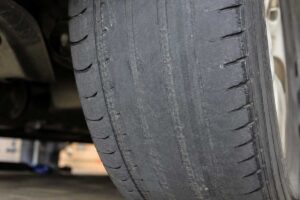
Tyre condition is one of the most critical — and most overlooked — aspects of motorhome safety. The key checks are:
- Tread depth: The legal minimum is 1.6mm, but 3mm or above is strongly recommended given the weight and braking distances involved
- Tyre age: This is the one many motorhome owners miss. Tyres should be replaced at a maximum of 6–7 years regardless of tread depth. Rubber degrades with age even when the tyre looks perfectly fine — and an aged tyre can fail without warning at motorway speeds
- Tyre pressure: Motorhomes require higher inflation pressures than cars, and pressures must be set for the loaded weight of the vehicle
- Condition: Cracking, bulging, or sidewall damage is particularly common on motorhome tyres that have spent months sitting static over winter
Steering and Suspension
The additional weight of a motorhome accelerates wear on steering and suspension components far more quickly than you’d see on a car. Shock absorbers, ball joints, track rod ends, and steering rack gaiters should all be inspected at every annual service. Any wear in these components is amplified by the vehicle’s weight and can significantly affect handling stability.
Coolant and Fluid Levels
Engine coolant, brake fluid, power steering fluid, and screen wash should all be checked, topped up, or replaced as required. Coolant should be renewed every two years to maintain its antifreeze protection and corrosion inhibitor properties — particularly important in a vehicle that may sit unused through winter.
Lights and Electrics
All vehicle lighting should be checked and failed bulbs replaced — this is an MOT failure point as well as a safety issue. The vehicle battery and charging system should also be tested; motorhomes place considerable electrical demands on the system compared to a standard vehicle.
Exhaust System
Motorhome exhausts lead a harder life than car exhausts, particularly if the vehicle regularly visits campsites with rough or unmade ground. A full inspection from the manifold to the tailpipe is part of a thorough annual service.
Does My Motorhome Need an MOT?
Yes — any motorhome over three years old requires an annual MOT. For motorhomes over 3,500kg GVW, this is a Class V test, which covers lights, brakes, steering, tyres, emissions, and chassis integrity.
As noted above, Class V testing requires specific equipment and authorisation that the majority of garages don’t hold. CSG Automotive in Macclesfield is authorised to carry out Class V MOT testing — contact us to confirm your vehicle’s class and book your test.
How Often Should a Motorhome Be Serviced?
At minimum, a motorhome should receive:
- Annual vehicle service — following the base vehicle manufacturer’s schedule
- MOT — annually once the vehicle is over three years old
- Brake fluid change — every two years regardless of mileage
- Coolant change — every two years
- Tyre replacement — by age (6–7 years maximum) as well as by tread depth
For low-mileage motorhomes — which describes the majority — the time-based intervals are the more relevant trigger across almost all of these items.
Conclusion
Motorhome ownership is one of the most rewarding ways to travel — but keeping your vehicle safe, legal, and reliable depends on finding a garage that’s genuinely equipped to look after it. For most motorhome owners in Macclesfield and across Cheshire, that’s harder to find than it should be.
CSG Automotive in Macclesfield has the facilities, equipment, and experience to carry out full motorhome vehicle servicing and Class V MOT testing. We serve motorhome owners across Macclesfield, Knutsford, Wilmslow, Congleton, Bollington, and Poynton — and we understand the specific demands these vehicles place on brakes, tyres, suspension, and the rest of the drivetrain.
Don’t leave your motorhome service to chance — book with one of the few garages in Macclesfield that can actually take your vehicle. Contact CSG Automotive today.
- Driving Abroad in 2026? Essential Car Checks Before You Go
- The Importance of Tyre and Wheel Alignment Services
- Signs Your Car Needs Professional Repairs
Frequently Asked Questions
Most workshops aren’t large or tall enough to accommodate a full-size motorhome, and standard car ramps often lack the weight capacity required. Motorhomes over 3,500kg also need a Class V MOT, which requires specific authorisation and equipment that most garages don’t hold. CSG Automotive in Macclesfield is equipped and authorised for both.
Yes. Motorhomes over three years old require an annual MOT. Those over 3,500kg GVW require a Class V test. CSG Automotive in Macclesfield holds Class V MOT authorisation and can test most motorhomes — contact us with your vehicle details to confirm.
Annually as a minimum, following the base vehicle manufacturer’s service schedule. For low-mileage motorhomes, the annual time interval is more relevant than mileage triggers. Brake fluid and coolant should be renewed every two years regardless of mileage.
Motorhome tyres should be replaced at a maximum of 6–7 years regardless of tread depth. The rubber degrades with age even when the tyre looks visually fine — and tyre failure on a heavy motorhome at speed can be extremely serious.
CSG Automotive services motorhomes on all common base vehicles including Fiat Ducato, Peugeot Boxer, Ford Transit, and Volkswagen Crafter chassis. Contact us with your vehicle details to confirm and book.
The Caravan and Motorhome Club: Motorhome maintenance advice
RAC: Motorhome servicing guide
GOV.UK: MOT testing classes and requirements