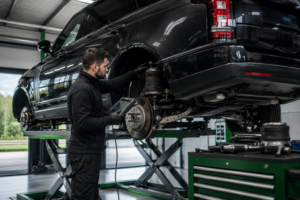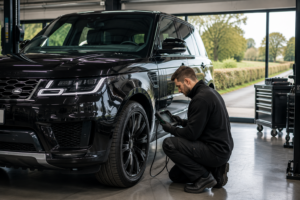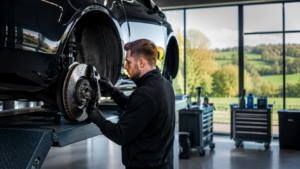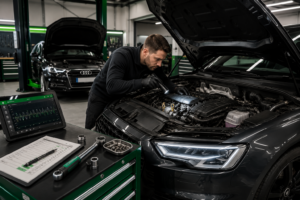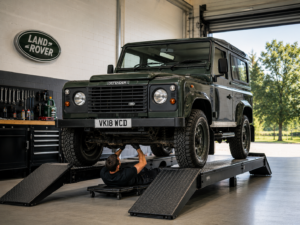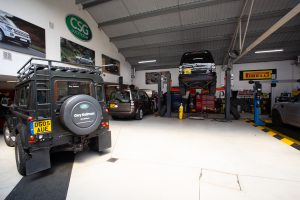
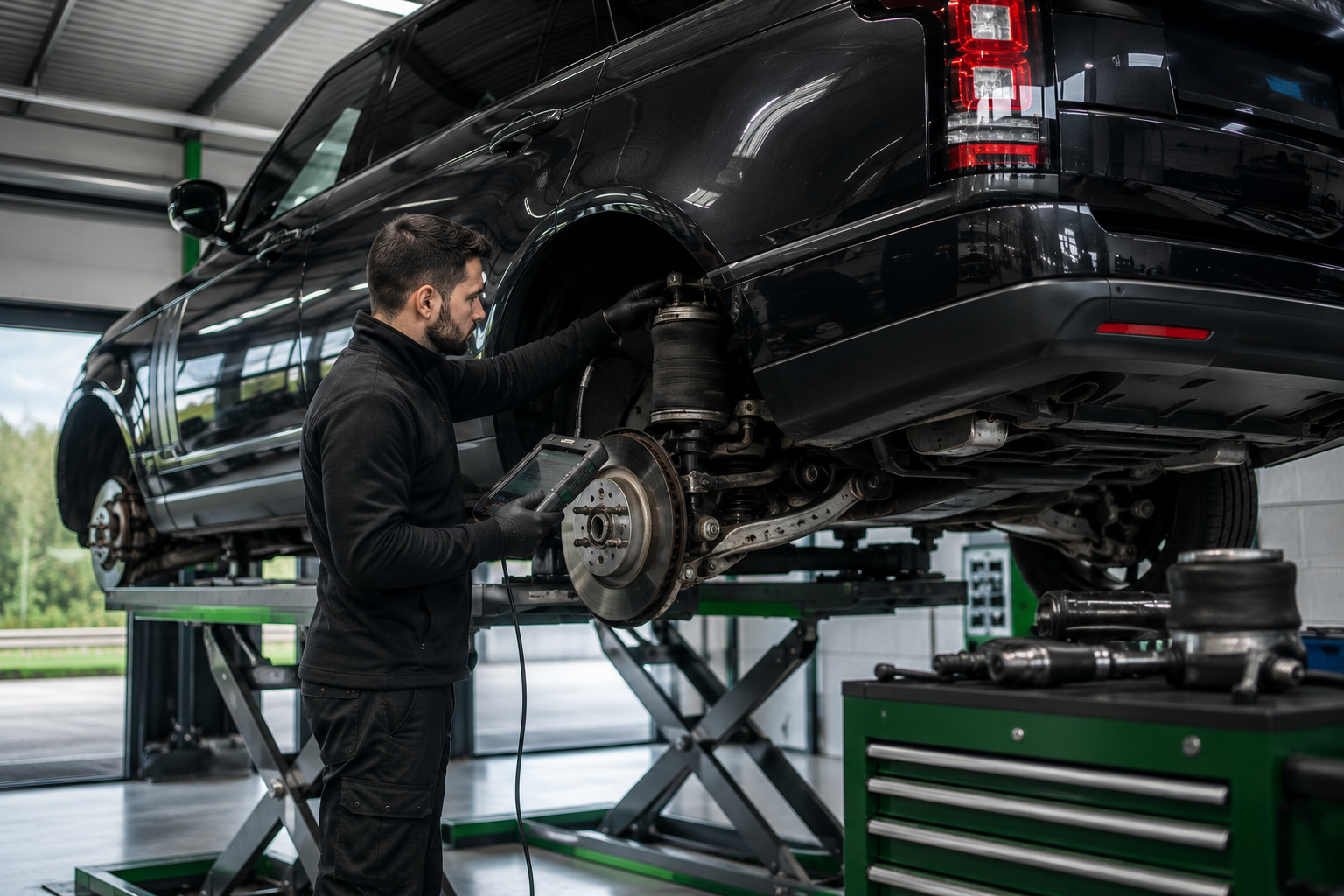
You climb into your Range Rover, glance in the mirror as you pull away, and notice the back end sitting lower than it should. Or you come out to the drive in the morning and the whole vehicle looks like it’s kneeling. Across Cheshire, this is one of the most common reasons Range Rover and Land Rover owners get in touch with us at CSG Automotive.
Range Rover air suspension faults are usually caused by perished air springs, a failing compressor, leaking air lines or connectors, or a faulty height sensor. Any of these can let air escape faster than the system can top it up, so the vehicle sinks overnight, settles unevenly at one corner, or drops noticeably once the engine is switched off. A proper diagnostic identifies which component is at fault before any parts are replaced.
Air suspension is one of the features that makes a Range Rover feel the way it does — settling smoothly over speed humps, lowering for easy entry, adjusting automatically for load. When it fails, that same clever engineering can feel like an expensive mystery. This guide sets out what goes wrong, why it happens, and how to get it looked at properly.
What Are the Most Common Range Rover Air Suspension Faults?
Air suspension systems rely on a sealed loop: air springs at each corner, a compressor to pressurise them, a valve block to direct air where it’s needed, and height sensors that tell the system how the vehicle is sitting. A fault in any one part throws the whole system off. In our experience working on Range Rover and Land Rover models across Macclesfield and the wider Cheshire area, the same handful of causes come up again and again.
Perished or split air springs
The rubber air springs (often called air bags) harden and crack with age and UK weather, especially where road grit and winter salt reach the bellows. A split spring leaks air constantly, so that corner of the vehicle sinks lower and lower until the system can no longer compensate. This is the single most common cause of a Range Rover sitting low at one corner.
Compressor failure
The compressor works hardest whenever the system needs to top up lost pressure, so a slow leak elsewhere often finishes off a tired compressor early. Once it can’t build pressure, the vehicle may sink evenly on all four corners rather than leaning to one side. A failing compressor is also often noisy, running longer and louder than it used to before a fault develops fully.
Air line leaks and corroded connectors
The narrow air lines that connect the compressor, valve block, and springs run close to the underside of the vehicle, where they’re exposed to road salt and moisture. Corroded fittings and perished lines are a very Cheshire-winter problem, particularly on vehicles that do a lot of short, cold-weather journeys. A slow leak here can be intermittent, which is why some owners only notice the sinking after the car has been parked overnight.
Height sensor faults
Height sensors tell the control module how the vehicle is sitting at each corner, so the system knows whether to add or release air. A faulty sensor can report the wrong height, causing the suspension to overcorrect, sit unevenly, or trigger a warning light even when the springs and compressor are fine. This is one of the faults most likely to be misdiagnosed without proper Land Rover-specific diagnostic equipment.
Valve block and solenoid issues
The valve block directs air to the correct spring on command. When a solenoid inside it sticks or fails, air can be routed incorrectly or leak internally, which sometimes shows up as a slow, hard-to-pin-down sinking fault rather than an obvious one. It’s one of the trickier faults to isolate without stripping back the diagnosis systematically.
Why Does My Range Rover Sink Overnight or Lean to One Side?
This is one of the most common questions we hear from Cheshire owners, and it’s a genuinely useful diagnostic clue rather than just a symptom to describe. The pattern of the sinking tells a technician a great deal before a single tool touches the car.
If the vehicle sits low evenly across all four corners, the cause is often a general loss of system pressure — a tired compressor struggling to keep up, or a slow leak somewhere central like the valve block. If one corner is noticeably lower than the rest, the fault is almost always local to that corner: a split air spring, a corroded line, or a sensor reporting incorrect height data at that wheel. Sinking that only appears overnight, when the vehicle has been stationary for hours, points to a slow leak that the compressor was masking during normal driving by topping up little and often.
Cold Cheshire mornings make all of this more noticeable. Rubber components stiffen in low temperatures, and a marginal leak that the system just about coped with in summer can become an overnight sink once autumn and winter set in. If you’ve started noticing the fault more since the weather turned, that’s a useful detail to mention when you book it in.
Main Dealer or Independent Specialist: Who Should Diagnose the Fault?
This causes the most hesitation, and it’s a fair question. Air suspension involves manufacturer-specific electronics, so it’s natural to assume only a main dealer can deal with it properly.
In practice, a specialist independent garage with genuine Land Rover and Range Rover experience — proper diagnostic software, height sensor calibration equipment, and technicians who see these faults every week — can diagnose and repair air suspension faults to the same standard as a dealer. The difference tends to be in the personal, unhurried service that an independent, family-run garage can offer. At CSG Automotive, our Land Rover and Range Rover division exists specifically because these vehicles need more than a generic diagnostic scan; they need technicians who understand how the air suspension system talks to the rest of the vehicle’s electronics.
What matters more than “dealer versus independent” is whether the garage has manufacturer-level diagnostic capability for Land Rover products, rather than a generic reader that can only tell you a fault exists somewhere in the system. A proper diagnostic identifies which corner, which component, and whether it’s an air leak, an electrical fault, or a sensor calibration issue — because guessing at air suspension repairs gets expensive fast.
Should You Repair the Air Suspension or Convert to Coil Springs?
For owners facing repeated air suspension faults, converting to a coil spring conversion kit sometimes comes up as an option, and it’s worth understanding honestly rather than being steered one way. Coil springs remove the air system’s moving parts entirely, so there’s nothing left to leak or fail in the same way. That appeals to owners who’ve had more than one air suspension repair and want to stop the cycle.
The trade-off is that a Range Rover is engineered around its air suspension — for ride comfort, load levelling, and the automatic lowering that makes loading and entry easier. A conversion changes how the vehicle rides and can affect its resale appeal to buyers who specifically want the factory air system. For most owners with a single, identifiable fault, a proper repair keeps the vehicle as the manufacturer intended and is the right first step. Conversion tends to make more sense only where the air system has failed repeatedly and the owner has decided ride comfort matters less than reliability. This is a decision worth talking through with a technician who can see the actual condition of your vehicle’s system, not a blanket rule.
Getting an Air Suspension Fault Diagnosed Properly
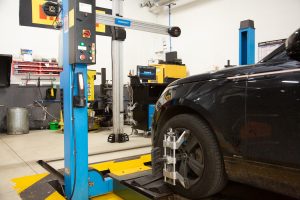
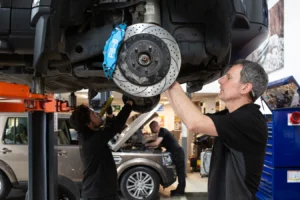
A reliable diagnosis starts with a full system scan using Land Rover-specific diagnostic software, checking stored fault codes across the suspension control module rather than just the warning light that prompted the visit. A physical inspection of each air spring, the visible air lines, and the compressor then confirms what the software is reporting, because fault codes and physical wear don’t always point to exactly the same place on their own.
Height sensors are checked and, where needed, recalibrated, since a sensor slightly out of alignment can mimic a leaking spring. Only once the faulty component is confirmed should parts be ordered or replaced. Owners across Alderley Edge, Wilmslow, Knutsford, Prestbury, and the rest of Cheshire bring their vehicles to us because this thorough approach avoids paying twice — once for a guess, and again for the actual fix.
Frequently Asked Questions
What are the warning signs of a Range Rover air suspension fault? The most common signs are the vehicle sitting visibly lower than normal, one corner sinking more than the others, a warning message on the dashboard referencing the suspension system, and the vehicle taking longer than usual to rise to normal height after starting. Some owners also notice the compressor running more frequently or more loudly than before a fault becomes obvious.
Can I keep driving my Range Rover if it’s sinking? A vehicle with a sinking air suspension fault can usually still be driven for a short distance, but it’s not advisable to continue for long. A sunken ride height affects handling and ground clearance and can strain other suspension components, so get it looked at as soon as you notice the symptom rather than waiting.
Is it cheaper to fix air suspension at an independent specialist than a main dealer? Independent specialists with genuine Land Rover diagnostic capability, like CSG Automotive, typically offer more competitive labour rates than a main dealer while diagnosing and repairing the fault to the same standard. Costs depend heavily on which component has failed, so it’s best to get a diagnostic first rather than assume the worst.
Should I repair my air suspension or convert to coil springs? Repairing the original air suspension is usually right for a single, clearly identified fault, since it keeps the vehicle riding as the manufacturer designed it. Coil spring conversion is worth considering only after repeated failures, and it changes the ride and may affect resale value, so it’s a decision best made with a technician who has inspected your vehicle.
How is a Range Rover air suspension fault diagnosed? A proper diagnosis starts with an electronic scan using Land Rover-specific diagnostic software to read fault codes from the suspension control module, followed by a physical inspection of the air springs, lines, and compressor. Height sensors are checked and recalibrated where necessary, and the faulty component is confirmed before any repair work or parts ordering begins.
Do all Range Rover models have air suspension? Most Range Rover, Range Rover Sport, and Range Rover Vogue models built over the last two decades use four-corner air suspension as standard, though the exact specification varies by model year and trim level. If you’re unsure whether your vehicle has air or coil springs, our technicians can confirm this quickly as part of a routine inspection.
In Summary
A Range Rover that’s sinking, sitting unevenly, or showing a suspension warning is telling you something specific — you just need the right diagnostic to hear it clearly. Left undiagnosed, a small air leak or a single worn sensor can turn into a bigger repair, so it’s worth acting on the symptom rather than living with it. Our Land Rover and Range Rover specialist team at CSG Automotive, based in Macclesfield and serving owners across Cheshire from Knutsford to Congleton, Sandbach to Bollington, deals with exactly this fault regularly and has the manufacturer-level diagnostic equipment to identify the cause properly the first time. Get in touch with the CSG Automotive team to book a diagnostic and find out exactly what your vehicle needs.