If you drive an electric car, the battery is the part you think about least and worry about most. A battery health check gives you a clear picture of what is going on inside it, without guesswork.
An EV battery health check reads the battery’s state of health, cell voltage balance and temperature data using diagnostic equipment, then compares the results with the manufacturer’s expected values. A technician also inspects the pack, cooling system, high-voltage cabling and charging port, and records everything in a report you can keep.
At CSG Automotive in Macclesfield, we carry out EV and hybrid diagnostics for drivers across Cheshire. Below, we walk through exactly what happens during an EV battery health check, step by step, so you know what to expect when you bring your car in.
Why Does an EV Battery Need a Health Check?
Every lithium-ion battery loses a little capacity over time. That is normal, and it happens in your phone and laptop too. In an electric car, the rate of loss depends on how the car is charged, how it is driven, how hot or cold it gets, and how many miles it has covered.
Most of the time you will not notice the change from one week to the next. You might see slightly lower range on a winter morning, or a charge that takes longer than it used to. A health check turns those vague impressions into measured data.
It also catches problems early. A single weak cell group, a faulty sensor or a cooling issue can show up in diagnostic data long before it becomes a warning light. Finding it early usually gives you more options.
What Happens During an EV Battery Health Check?
The exact process varies by make and model, but our checks follow the same broad sequence. Here is what our technicians do.
1. A conversation about how you use the car
We start by asking about the car’s history. How often do you rapid charge? Do you mostly charge at home? Have you noticed reduced range, slower charging, warning messages or unusual behaviour? Has the car been left unused for long spells?
2. A visual and physical inspection
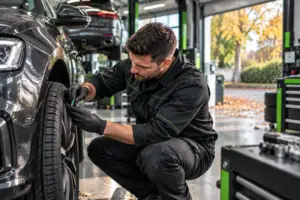
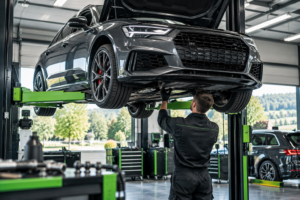
Before connecting any equipment, we look over the areas that can be seen safely. That includes the charging port, the visible high-voltage cabling and connectors, the underside of the vehicle where the battery pack sits, and the coolant levels in any thermal management system.
We are checking for damage from road debris or speed bumps, corrosion, leaks, loose fittings and signs of previous repairs. Cheshire lanes and country roads can be hard on underbodies, so this step matters more than people expect.
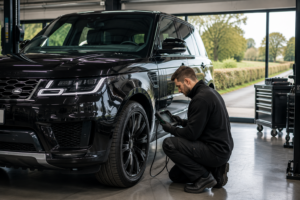
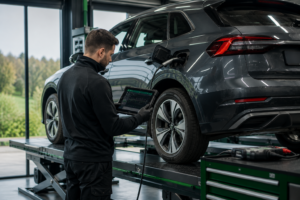
3. Connecting the diagnostic equipment
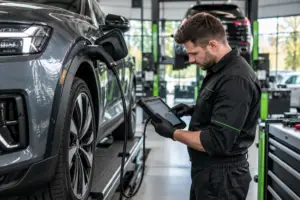
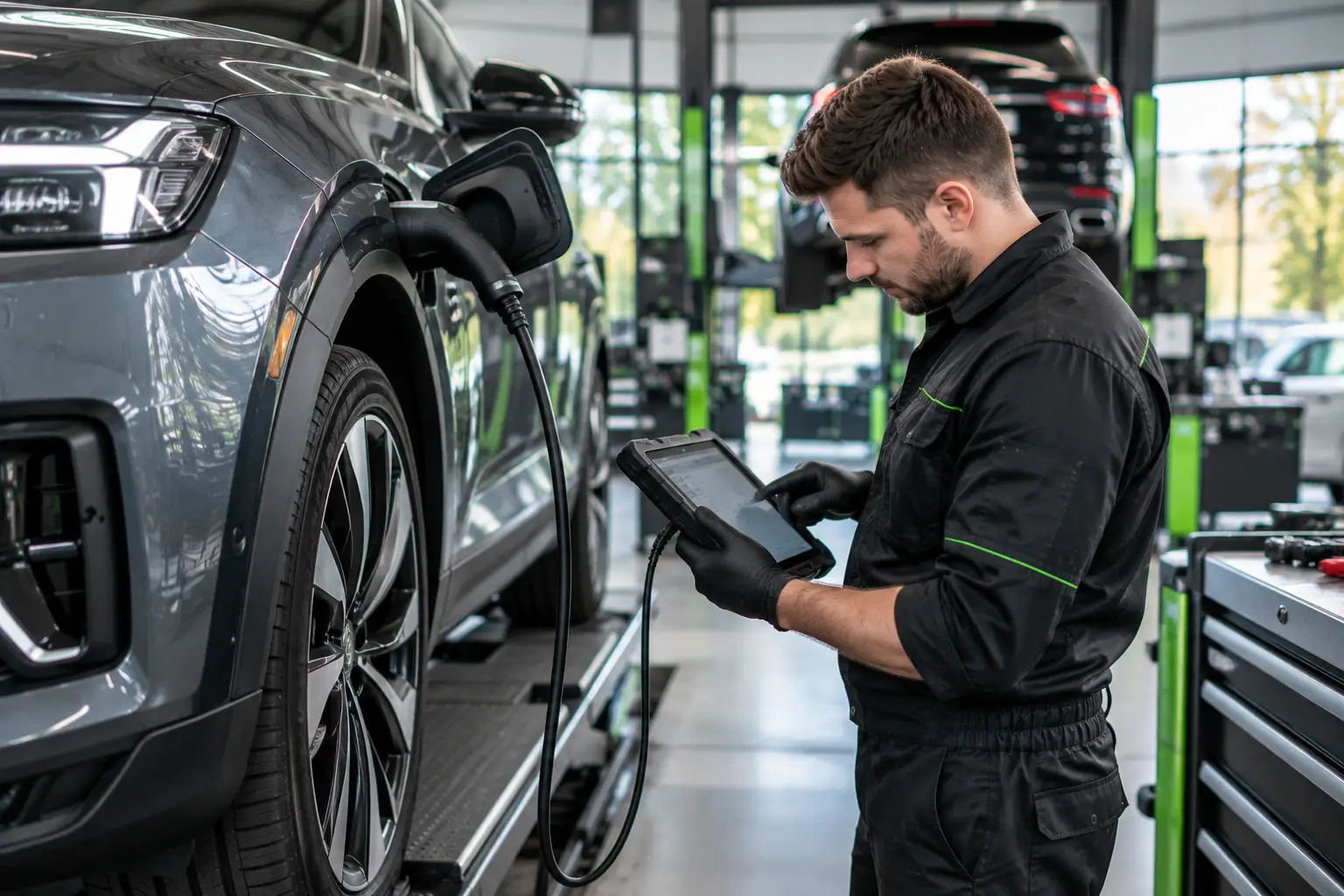
Next, we connect specialist diagnostic equipment to the car’s diagnostic port. This lets us communicate with the battery management system, the module that monitors and controls the high-voltage battery.
Working on high-voltage systems requires specific training and procedures, which is one reason this is not a job for a general-purpose code reader.
4. Reading the state of health
The headline figure is the battery’s state of health, often shortened to SoH. It compares the battery’s current usable capacity with what it was when new.
Different manufacturers calculate and report this in different ways, and some cars expose more data than others. We explain which figures are available for your car and what they do and do not tell you.
5. Checking cell balance and voltage
An EV battery pack is made up of many individual cells grouped into modules. They should hold similar voltages. If one group sits noticeably lower than the rest, it can limit how much of the pack’s capacity you can actually use.
We review the voltage readings across the pack and look for outliers. This is often the stage where an early problem shows itself, even if the overall state of health looks acceptable.
6. Reviewing temperatures and thermal management
Batteries work best within a particular temperature range, and electric cars use heating and cooling systems to keep them there. We check the temperature readings across the pack and look at whether the thermal management system is behaving as expected.
A cooling fault can quietly shorten a battery’s life, so we treat this as a key part of the check rather than an extra.
7. Scanning for fault codes and software updates
We scan every relevant control module for stored fault codes, including those that have not triggered a dashboard warning. We also check whether any software or firmware updates are outstanding for the battery management system.
8. Looking at the 12V battery, too
It surprises many owners, but a flat or failing 12-volt battery is a common reason for an electric car refusing to start or showing a string of unrelated warnings. We test it as part of the check because it can mimic a much bigger problem.
9. Charging system and port checks
Finally, we inspect the charging port and associated components for wear, heat marks or damage. Where the car’s data allows, we also review its charging history and look for anything unusual, such as repeated charge interruptions.
What Will You Get at the End of the Check?
You get a written summary of what we found, explained in plain English. That normally covers the state of health reading, any cell or temperature concerns, fault codes, the condition of the 12V battery and charging components, and our recommendations.
We separate what needs attention now from what simply needs monitoring. If nothing is wrong, we say so. If something needs work, we explain the options before any repair is booked in, and you decide what happens next.
How Do You Read Your Battery Health Results?
Numbers on their own can be confusing, so here are the main things we help owners make sense of.
State of health is not the same as range
A lower state of health means less total capacity, which can reduce range. But range is also affected by temperature, speed, tyre pressures, heating use and how much weight you carry. A good result does not guarantee identical range in every condition.
Some degradation is normal
Every battery ages. What matters is whether the rate of loss looks reasonable for the age, mileage and use of the car.
Warranty coverage matters
Many manufacturers offer a separate warranty on the high-voltage battery, often with its own time and mileage limits and, in some cases, a minimum capacity threshold. The terms vary between brands, so check your paperwork.
If your result looks lower than expected, we can talk you through whether it is worth raising with the manufacturer or dealer.
When Should You Book an EV Battery Health Check?
There is no single right moment, but these situations make a check worthwhile:
- You are buying a used electric or hybrid car and want evidence beyond the dashboard display.
- Your range has dropped noticeably, and you cannot explain it by weather or driving style.
- A battery, charging or powertrain warning has appeared.
- Rapid charging seems slower than it used to be.
- Your battery warranty is approaching its end, and you want a record before it does.
For many owners, a check alongside a routine service is the easiest way to fit it in.
Can Hybrids Have a Battery Health Check Too?
Yes. Hybrids have a high-voltage battery as well, though it is usually smaller than the one in a fully electric car, and it works differently. It is constantly charging and discharging as you drive, so its condition affects fuel economy and how smoothly the car runs.
The checks available vary between manufacturers and models. We confirm what we can read on your hybrid before booking.
What Can You Do Between Checks to Look After Your Battery?
A few habits help most electric cars, although your handbook should always come first.
- Avoid leaving the car at very high or very low charge for long periods, where the manufacturer advises it. Many suggest everyday charging to a limit below 100 per cent.
- Use rapid charging when you need it, not as a default. Home charging is gentler on most batteries.
- Keep the car serviced. Coolant, software updates and the 12V battery all affect the high-voltage system.
- Do not ignore warning messages. Get them looked at promptly.
Frequently Asked Questions
What is an EV battery health check?
An EV battery health check is a diagnostic assessment of a high-voltage battery pack. A technician connects specialist equipment to read the state of health, cell voltage balance, temperatures and fault codes, then inspects the pack, cooling system and charging components. You receive a report showing how the battery is performing.
How long does an EV battery health check take?
The time depends on the vehicle, the diagnostic route and whether any faults turn up. A straightforward check is usually completed within a single visit, but a car that needs further testing may stay longer. We confirm the likely timescale when you book, then update you if anything changes.
Can a battery health check tell me how much range I have lost?
It shows the battery’s state of health, which is the main indicator of lost capacity, and that helps explain changes in range. Range also depends on driving style, temperature, tyre pressures and load, so the result is one part of the picture rather than a promise of exact miles.
Do hybrids need a battery health check too?
Yes. Hybrid vehicles also carry a high-voltage battery that ages with use, and it can be assessed in a similar way. The checks vary between models and manufacturers, so we confirm what is possible for your particular hybrid before we start.
When should I book an EV battery health check?
Good times to book include before buying a used EV, when you notice range dropping faster than expected, if a warning light appears, or after the car has sat unused for a long period. Some owners also book one ahead of selling, so the buyer can see documented evidence.
Will a battery health check affect my warranty?
A diagnostic check on its own does not repair or alter the battery, so it should not normally cause a problem. Warranty terms differ between manufacturers, so check your own paperwork or ask your dealer for confirmation.
Book Your EV Battery Health Check in Macclesfield
An EV battery health check gives you facts instead of guesswork, whether you are keeping the car for years or thinking of selling it. At CSG Automotive, our technicians will take you through the results in plain English, without pressure.
If you would like us to look at your electric or hybrid car, get in touch with our Macclesfield garage to book. We are happy to talk through what is involved first.