

A rattle from the engine on a cold start is the kind of noise that makes any Discovery owner go quiet in the driver’s seat. At CSG Automotive in Macclesfield, we see Land Rover Discovery timing chain problems often enough to know that the owners who act early usually keep their repair bill, and their engine, intact.
What are the signs of Land Rover Discovery timing chain problems? The main warning signs are a rattling or whining noise from the engine on start-up, a flashing engine management light, rough running or misfires, loss of power, and difficulty starting. A stretched or failing chain can also let the timing drift, which risks serious engine damage if the car keeps being driven.
What does a timing chain actually do?
Inside your engine, the crankshaft and camshaft have to turn in perfect step. The crankshaft is driven by the pistons, while the camshaft opens and closes the valves that let air in and exhaust out. The timing chain links the two, so the valves open at exactly the right moment in each piston’s cycle.
Unlike a rubber timing belt, a chain is metal and runs inside the engine, lubricated by engine oil. That is why many owners assume it is a fit-and-forget part. In reality, a chain system is more than a chain. It includes tensioners, guides, sprockets and, on many engines, hydraulic components that rely on clean oil at the right pressure. Any of those can wear, stick or fail before the chain itself gives up.
When timing drifts or the chain jumps a tooth, the engine can lose power, run roughly or stop altogether. On some engines, particularly diesels, the pistons and valves can then collide, which turns a repair into a rebuild.
Which Discovery engines are most affected by timing chain problems?
Timing chain wear can turn up on a number of Discovery engines, and the pattern differs between generations. It is worth knowing which engine is under your bonnet before you read anything into a noise.
Discovery 3 and Discovery 4 diesels. The 2.7 and 3.0 litre V6 diesels use a chain system, and on the 2.7 in particular the timing components sit at the rear of the engine, which makes any work on them labour-intensive.
Discovery 5 and Sport-era Ingenium engines. Later Discovery models use the Ingenium four-cylinder diesel and petrol engines, and the 3.0 V6 diesel. Owners and specialists have reported chain-related concerns on some of these.
Petrol V8 and supercharged V6 models. These also use chains rather than belts. Wear shows up differently here, usually as rattles on start-up or fault codes linked to timing correlation.
We do not want to scare anyone. Plenty of Discoverys cover very high mileages with their original chains. The point is that a chain is a wear item whose life depends heavily on how the engine has been looked after, and the car’s age and mileage tell you less than its service history does.
Why do Discovery timing chains wear or fail?
In our experience, the causes tend to fall into a few groups.
Oil that has been left too long
Hydraulic tensioners use engine oil pressure to keep the chain tight. Dirty, degraded or incorrect oil makes them sluggish, and a slack chain starts to slap against the guides. Stretching long service intervals is the most common thing we see behind a chain that has aged early.
Short journeys and cold starts
Most chain wear happens in the first few seconds after a cold start, before oil has fully reached the tensioners. A Discovery that mostly does short school-run trips around Macclesfield and Prestbury rarely gets the chance to settle. The oil does not get properly hot, which also accelerates sludge formation.
Worn guides and tensioners
The plastic guides along the chain’s path harden and wear over time, and a tensioner can lose its ability to hold pressure. Debris from a degrading guide can also travel into the oil system. A chain that looks fine on inspection may still have failing components around it.
Age and mileage
Eventually every chain stretches. Heavy towing, off-road use and sustained loads all add to the strain, and Discoverys tend to do plenty of all three.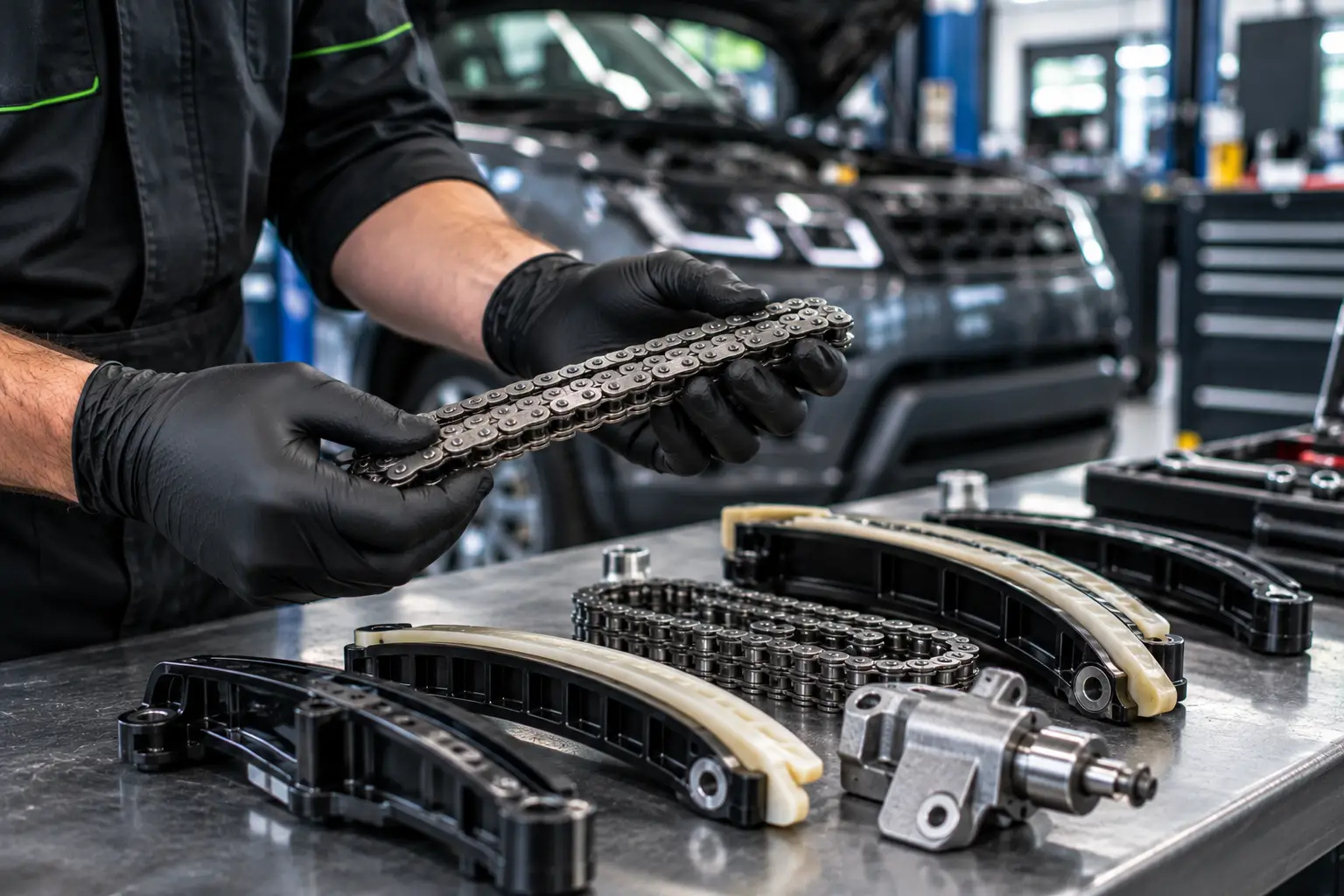
How can you tell if your Discovery has a timing chain problem?
Some symptoms are obvious. Others are easy to explain away for months. Here is what we would ask you to watch for.
- A rattle or whine on cold start that fades as the engine warms. This is the classic early warning.
- A constant rattle or metallic ticking from the front or rear of the engine at idle.
- Engine management warning light or fault codes pointing to camshaft and crankshaft correlation.
- Rough idle, misfires or hesitation, particularly under load.
- Loss of power, or the car going into limp mode.
- Long cranking before the engine starts, or a failure to start at all.
- Metallic debris in the oil found during a service. Our technicians always check for this.
None of these automatically means a failed chain. A noisy start can also come from a failing tensioner, a loose heat shield, a worn belt-driven component or another issue entirely. That is why a proper diagnosis matters more than a guess, and why we would rather look at a noise early than quote for an engine later.
What should you do if you hear a rattle?
If you suspect a timing chain issue, the safest approach is to stop driving the car as soon as it is practical, particularly if the engine light is flashing or the engine is running roughly. Continuing to drive on a stretched chain can let the timing slip further.
Here is what we recommend:
- 1. Note exactly when the noise happens. Cold start only, constantly, or under load? That detail helps our technicians narrow things down quickly.
- 2. Check the oil level and condition. Low or very dirty oil is a red flag, but do not top up and carry on as though nothing happened.
- 3. Avoid heavy loads and high revs. Do not tow with a suspected chain problem.
- 4. Book a diagnostic check. We use Land Rover-capable diagnostic equipment to read the fault codes and assess chain stretch, rather than guessing from the noise alone.
If the car has already stopped or will not start, do not keep cranking it. Repeated attempts can make the damage worse. Call us and we can advise on the next step.
What does a Discovery timing chain repair involve?
The honest answer is that it depends on the engine and on how early the problem is caught. A chain job is not a quick one on most Discoverys, because the timing components often sit behind the engine’s ancillaries or, on some models, at the back of the engine. On those layouts the gearbox or engine access work adds significantly to the labour.
A proper repair normally replaces the chain together with the tensioners, guides and sprockets, rather than just the chain. Fitting a new chain onto worn components tends to bring the problem straight back. We also look at what caused the wear, such as oil condition or a related fault, so that the fix lasts.
We would rather give you a clear written quote after diagnosis than a ballpark figure over the phone. If the engine has already suffered internal damage, we will explain the options plainly, including whether a repair or an engine replacement makes more sense for your vehicle.
How can you protect a Discovery timing chain?
Prevention is much cheaper than repair, and most of it comes down to routine care.
- Service on time, with the correct oil. This is the single biggest factor. Do not stretch intervals on a Discovery you plan to keep.
- Let the engine settle. Avoid hard revving straight after a cold start, and try to mix in some longer runs.
- Act on noises promptly. A tensioner replaced early costs far less than a chain job that has gone wrong.
- Ask for a chain check at service time. Our technicians can listen for chain noise and check the oil for debris as part of a service.
- Buy with care. If you are looking at a used Discovery, ask for the full service history and have the engine checked before you commit.
As an independent Land Rover and Range Rover specialist, we spend our days working on these vehicles, so we know the common failure points and what to look for on each model.
Frequently asked questions
How much does it cost to fix a Discovery timing chain?
The cost depends on the engine, the model and whether the chain, tensioners, guides and sprockets all need replacing. Labour is a major part of the bill because of the access involved. We give a written quote after diagnosis rather than a guess over the phone.
Can I drive my Discovery with a rattling timing chain?
It is not advisable. A rattle can mean the chain is stretched or the tensioner is failing, and continuing to drive risks the timing slipping, which can cause serious engine damage. If the engine management light is flashing or the car is running roughly, stop driving and have it checked.
How long should a Land Rover Discovery timing chain last?
A timing chain is designed to last a long time, but there is no single mileage that applies to every Discovery. Lifespan depends on the engine, how often the oil has been changed, driving style and load.
Is a rattle on cold start always a timing chain problem?
No. A brief rattle on a cold start is a common early sign of chain or tensioner wear, but other parts can cause similar noises, including ancillary components and loose shields. A diagnostic check is the only reliable way to tell the difference.
Do Discovery timing chains need servicing?
A timing chain does not have a fixed replacement interval like a belt, but it does need the right care. Regular oil changes with the correct specification keep the tensioners working properly, and a technician can listen for noise and check the oil for debris at each service.
Can an independent garage repair a Discovery timing chain?
Yes. An independent Land Rover specialist can diagnose and repair timing chain faults, provided it has the right tooling, technical data and experience with the engine. At CSG Automotive in Macclesfield, we work on Land Rover and Range Rover vehicles every day.
Worried about a noise from your Discovery?
If your Discovery is rattling on a cold start, showing a warning light or simply feels different, do not leave it and hope. A diagnostic check now is far cheaper than an engine repair later. At CSG Automotive, our Macclesfield technicians will find the cause, explain it in plain English and give you a clear written quote before any work begins. Get in touch to book your Discovery in.